




FAQs
General Questions


-
Yes, we offer brief consultations to help determine if Spiral Roots LLC and Melissa are the best fit for you. Please contact me to schedule a consultation, and we can discuss your needs, goals, and how our services may support your young person’s growth.
-
You can schedule a session by contacting Melissa directly at melissa@spiralroots.org or 540-416-1628.
Once initial contact has been made we can schedule a short call to determine if this is a good fit and set up a session time.
-
As a trauma informed provider, I like to find a day and time that can be consistent. This helps both with your planning as a caregiver and the child and teens being prepared for a positive therapeutic experience.
Predictability helps create stability and safety for dysregulated individuals. When there are life scheduling issues the day and time can be adjusted.
-
Typically, I like to meet for at least five consecutive weeks to build a relationship before adjusting time between sessions. Trust and relationship are fundamentally important to positive change, reduction of symptoms, and growth in teens and children.


-
Sessions are scheduled for 60 min blocks. However, they may end early at times if therapeutically necessary or previously arranged by care giver.
-
Cancellations or missed sessions that are not rescheduled within the same week will be automatically charged the full session fee. These absences may not be reimbursed by insurance and are the responsibility of the client.
When you schedule services with me you are scheduling a time slot. A time slot is reserved for you and cannot be immediately filled or replaced by another person. My ability to continue to serve you depends on having a predictable income.
If something arises, I will work with you to see if there is another time frame that works for both of us. This cannot always be guaranteed.
There are times when we can switch to Zoom to accommodate services especially in the event that the client or the therapist is sick.
-
Yes, I do provide telehealth, however I prefer in person when working with children and teens. Especially if they are really struggling. When we meet face to face there is a different, felt sense of being seen and heard. Attention spans are longer, there are fewer distraction, and the therapeutic space is neutral and safe. There are more ways to change direction in a session when children or teens are not responsive to a particular invitation or modality. Reading body language is easier in person and is essential to working with children and teens who are having a hard time talking or interacting.
I use the Zoom platform when providing telehealth and request that the video be on.
-
It is preferable for a therapist not to be involved in a court dispute.
If I am subpoenaed or requested to attend court as a therapist I will provide facts as I understand them and am not able to give an opinion in court.
If a court document is requested or if your therapist is required to appear in court by a subpoena, a separate signed payment agreement must be completed prior to any documentation or court appearance. There are specific fees for court documentation and appearances. Please ask for the Financial Agreement for Court if this may be an issue.


-
For the first session I typically ask for a caregiver to be present with the client so that we can verbally review paperwork and answer any questions. During the first session, we will review a little bit about what therapy is, what the family and client’s concerns are, and a few forms. After formal introductions, paperwork, and questions are done if there is time we may engage in an activity or game that is less stressful to begin building a relationship. At this time, I will invite your child or teen to decide if they would like you to remain for the rest of the session or not. I believe it is important to begin with giving a young person agency over their therapy. I believe that clients always have the right to say “no” if they do not want to do a particular activity or if topics are too stressful in the moment. The first few sessions are important for creating emotional safety and relationship building.
-
As a licensed therapist, information remains confidential even when working with children and teens.
However, I am clear with families and teens that if there is a safety concern and or abuse the client will be invited to engage in a conversation with their parent/guardian and the therapist regarding the issue as is appropriate.
Parents and Guardians are welcome to enter sessions as needed. Open communication is welcome. Information will not be withheld between caregivers, separated caregivers, or caregivers and clients.
The therapist may give support and guidance to the parent and caregiver as is needed and appropriate.
I believe that parents and caregivers are integral parts to the stability and growth of their young ones. I believe that the therapist, child or teen, and caregivers are a team all working together for sustainable growth and changes.


-
Melissa Deaton Cook LPC uses a strength based, integrative approach of trauma informed expressive arts, play therapy, nature-based therapy, sand tray therapy, experiential therapy, and cognitive therapy. She meets each individual where they are on their journey with no judgment. Therapy is a joint process where the therapist is a wise guide and companion. Laughter, tears, anger, sullenness, disagreement, or silliness can show up in any session. Melissa’s goal is to create a safe environment where she gives the client agency to direct treatment at their pace. Melissa seeks to intertwine a client’s personal interests, strengths, and curiosities with therapeutic wisdom to enable growth and change.
-
Expressive arts therapies integrate mark making, sound, movement, and storytelling. It integrates these elements including somatic and body awareness practices to support trauma recovery and growth.
-
Play is the language of children. Play is used as a therapeutic tool to help children, teens, and adults explore and express their emotions, thoughts, and experiences. Games, toys, play dough, and other things are used to engage the individual through the senses and move them towards growth and well being. It is a fact that we learn more when we have fun and play at any age.
-
Sand tray is an expressive form of therapy that uses a variety of sand, a sandbox and miniature figures to help individuals externalize and process thoughts, difficult emotions, and experiences. Sand trays are used with all ages to promote healing and growth.
-
Music based therapy uses instruments, sound, songs, recordings etc as tools to enhance the therapeutic process. Spiral Roots LLC has drums, percussion, and squeaky chickens available for use during therapy sessions. Melissa Deaton Cook is not a music therapist but uses music as a tool.
-
Nature based therapies integrate elements in nature into all aspects of therapy. This could be through interaction of natural elements or the use of them through metaphor, mark making, sound, movement, and storytelling. Nature based therapies can involve going outside and experiencing nature firsthand during a session.
-
During talk therapy I integrate modalities such as Cognitive Behavior Therapy, Choice Therapy, Reality Therapy, Family Therapy, IFT, Experiential therapies and more.
-
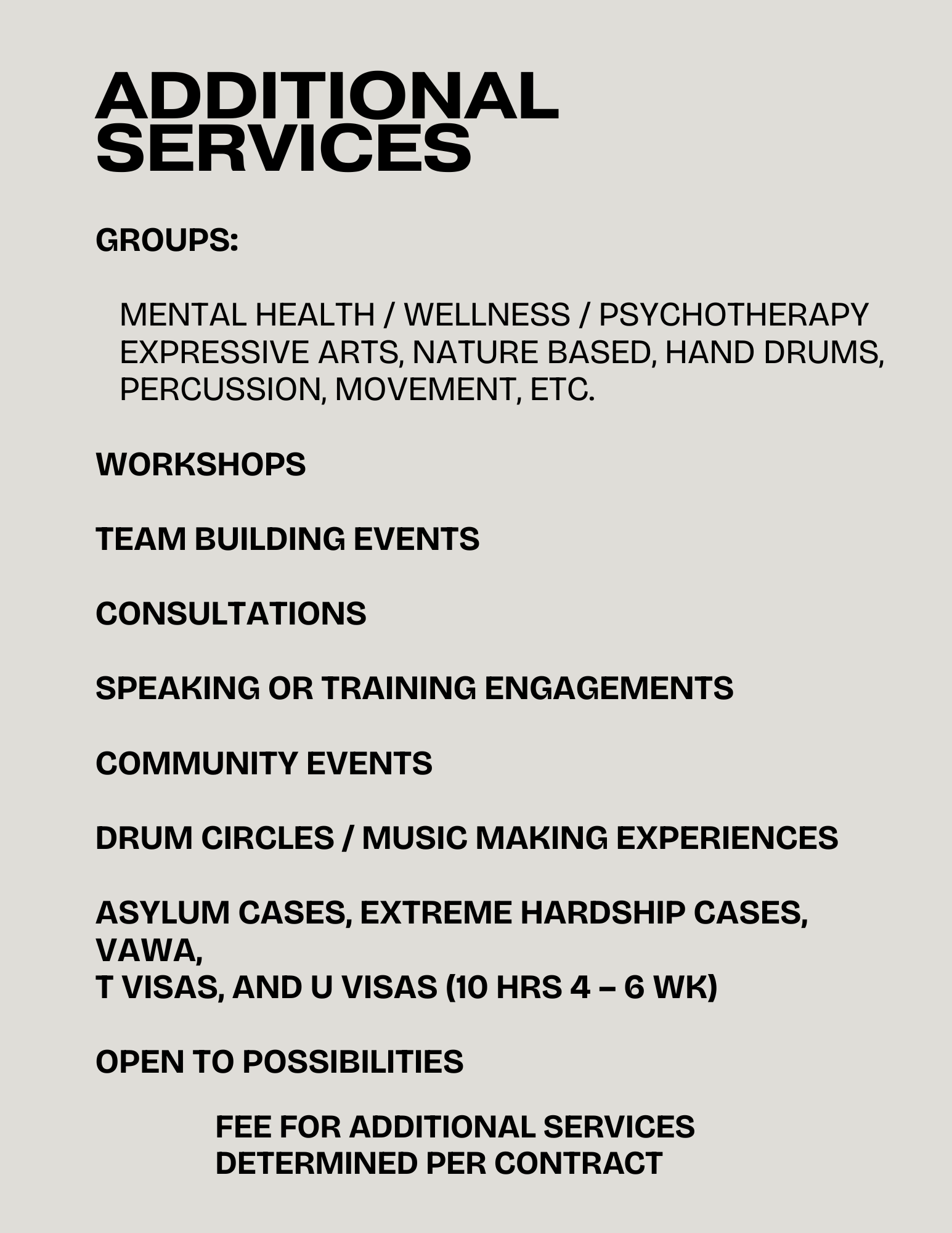
Melissa is available to be contracted for workshops, team building, training, and speaking engagements. Melissa will work with the organizations needs to develop the most effective presentation that may include expressive arts, drum circles, and didactic presentations.
FAQs
FAQs
Pricing Questions


General Payment Questions
-
Payments may be made by cash, checks, or credit cards, debit, HSA and FSA cards. Credit card payments are through a secure platform.
Spiral Roots currently uses Thrizer to process credit cards, debit, HSA and FSA cards. Thrizer is a HIPAA-secure platform that processes credit, debit, HSA and FSA cards.
Payment is due at the time of the session.
-
Currently, rates are set to reflect the value and expertise involved in these specialized therapies. Spiral Roots cannot provide a sliding scale.
-
If you participate in Medicare, please be aware that I have opted out. This means that you agree that neither you or I will submit any superbill to Medicare for reimbursement at any time.
-
I am an approved vendor for multiple DSS departments in the State of VA.




Insurance?
-
Spiral Roots does not accept insurance.
Spiral Roots can provide a super bill to your insurance company as an out -of -network provider if this is a provision within your insurance. If A super bill is used the insurance company will have the right to request your records and will require a diagnosis as if you were receiving in-network services.
-
A superbill is a detailed, itemized invoice for healthcare services that serves as a patient's record and a key tool for out-of-network reimbursement. It includes the provider's information, patient's demographic, insurance information, service details such as diagnosis, type of service, and time frame, and financial Information. The client submits the superbill to their insurer for partial or full reimbursement of out-of-pocket costs.
At Spiral Roots the HIPPA- secure electronic platform can automatically submit a superbill to your insurance company.
-
An out-of-network provider is a healthcare professional who does not have a contract with your health insurance plan. This means all fees will be paid directly out of pocket at time of service.
Many Health Insurance Plans will re-imburse a portion of the fee if a super bill is provided. As all insurance contracts are different please check with your insurance provider to see if and how much they reimburse services from an “out-of-network provider”. Refer to your insurer's provider directory or contact them directly. If a super bill is submitted and processed your insurance company will then send the amount they reimburse directly to you. Reminder: Full payment is due at the time of the session unless otherwise discussed.
-
Paying for a private fee or out-of-network therapist frequently offers more specialized expertise, more experience, greater treatment flexibility and personalization, and enhanced privacy due to less insurance involvement. The agenda is that of the client not the insurance company.
For children and teenagers, insurance requires a diagnosis that could potentially follow the young person for life. Privet pay is a good option for those with complex needs or who prefer a less restricted therapy experience. It is also a good option for clients who have struggled with therapy in the past as a private pay therapist frequently has more experience and the ability to titrate (simplify/slow down) therapy for highly complex or crisis-based cases.
Since the total amount of the payment goes directly to the therapist, the therapist is able to invest in specific training and therapeutic tools that may be needed to help with the specific needs of your loved one. For example, the purchase of specific books, musical instruments, games, or toys that speak directly to interest or language of a child or teen can facilitate growth and understanding of a client.

-
You have the right to receive a “Good Faith Estimate” explaining how much your medical and mental health care will cost. Under the law, health care providers need to give patients who don’t have insurance or who are not using insurance an estimate of the expected charges for medical services, including psychotherapy services. You have the right to receive a Good Faith Estimate for the total expected cost of any non-emergency healthcare services, including psychotherapy services. You can ask your health care provider, and any other provider you choose, for a Good Faith Estimate before you schedule a service. If you receive a bill that is at least $400 more than your Good Faith Estimate, you can dispute the bill. Make sure to save a copy or picture of your Good Faith Estimate. For questions or more information about your right to a Good Faith Estimate, visit www.cms.gov/nosurprises.


Payment Processing
-
Thrizer is an online payment system that processes cards.
I will send you an invitation or you can create your profile page before hand and link Melissa Deaton Cook LPC to it.
I never have access to your card other than to click a payment button.
-
Thrizer is a HIPAA-secure electronic payment system that keeps your card on file to automatically charge your card after each session.
If a super bill is requested they can automatically submit them to your insurance company.
-
*Once set up Thrizer automatically charges you when Clinician indicates a payment is needed.
*Thrizer can check your insurance benefits for you quickly with no charge.
*Thrizer can automatically create and submit insurance claims (superbills) and handle reimbursements quickly for a fee. See the document on Thrizer or go to https:/www.thrizer.com/for-clients or https://www.thrizer.com/pricing
What Goes into the Cost of Therapy?
-
A licensed therapist has a graduate degree, followed by years of supervision, and then an examination by a licensing board. After all this a Licensed therapist must pay yearly for the continuation of their license, multiple hours of continuing education, liability insurance, and recommended professional memberships. Therapists frequently pay for ongoing specialized consultation and supervision to ensure the best care for their clients.
A good therapist will choose wisely to enhance their knowledge in the niche area that they enjoy working in. For Melissa Deaton Cook this starts with all things related to children, teens, and families. Therapists then continue to advance their knowledge by pursuing different certifications such as expressive arts trauma informed, sand tray therapy, nature-based therapy, somatic therapy, expressive arts therapy etc to better help those they serve.
-
Rent, utilities, marketing, software, office supplies, building / renters insurance, furniture, and sometimes building maintenance etc. As with all businesses these costs increase yearly.
-
A child and teen therapist typically have additional costs related to play therapy. They purchase toys, creativity supplies, games, books, sand, sand tray items etc. Melissa Deaton Cook will frequently buy an addition to her tools if something really resonates with a child or teen. For example, recently a teen expressed a memory / interest in a güiro instrument. After purchasing and introducing this instrument to the teen there was a more rapid shift in growth, stabilization, and trust in the therapist. If a child likes bubbles and they present as a doorway to change Melissa will purchase more bubbles. This does not mean that anything a child or teen mentions will be obtained but since play, creativity, and music are the language of kids if something is reasonable it will be considered.
-
Therapists spend time planning, documenting, and consulting on your care. Manny of these things also have added costs.
-
A therapist has a set number of hours a week that they can provide services. These time slots are what pay the bills and keep the therapist’s doors open to help your child or teen who is in need. Each hour is allocated to a specific client. If that client cancels there is not another person waiting to fill that spot. So think of it as paying for the time of a therapist. A therapist has a finite number of clients that fit the number of hours in a week unlike a dentist or dr who can pull from a long list of people waiting for services.